
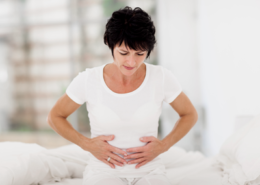
Sudden Tummy Trouble? Perimenopause Can Cause New Food Sensitivity!
Perimenopause, Hormones & Gut Health
One of the more disorienting experiences of midlife is discovering that foods a woman has eaten happily her entire life have suddenly turned on her. Dairy that never caused a problem now brings bloating. A glass of wine leads to a rough night. Bread, beans, or onions produce cramping that seems to come out of nowhere.
What makes this so confusing is that nothing about the diet has changed. The change is happening upstream, in the hormonal environment that has been quietly governing digestion for decades.
At Prosperity Health in Oakland County, functional medicine doctor Nishath Hakim regularly sees women in their thirties and forties who arrive convinced something is seriously wrong with their digestive system. But in many cases their gut is responding exactly as it should – and the problem is a hormonal signal that has shifted. Understanding that connection changes everything about how sudden digestive problems during perimenopause are approached – so that you can get back to enjoying the foods that you love withut discomfort.
How Perimenopause Hormones Alters the Gut
Estrogen and progesterone receptors are present throughout the digestive tract, from the esophagus down through the colon. These hormones influence how quickly food moves, how much mucus lines the intestinal wall, and how tightly the cells of the gut lining hold together.
Progesterone in particular acts as a smooth muscle relaxant, which slows transit time. As progesterone becomes erratic and then declines during perimenopause, motility can swing between sluggish and hurried, sometimes within the same week.
Estrogen supports the mucosal barrier and helps maintain healthy blood flow to the intestinal lining. When estradiol drops, that barrier becomes less resilient and more reactive to ordinary irritants.
Digestion itself becomes less efficient at the same time. Stomach acid production tends to decline with age, and bile flow can slow, which together mean proteins and fats are broken down less completely before they reach the small intestine.
Because these shifts are gradual and inconsistent, they are easy to miss. Dr. Hakim takes a detailed symptom timeline for every patient at Prosperity Health in Oakland County, because the pattern of when digestive changes began often points directly at perimenopause as the underlying driver.
Perimenopause Symptoms that Seem Like IBS
The digestive complaints that accompany perimenopause overlap almost perfectly with irritable bowel syndrome. Bloating that worsens through the day, alternating constipation and loose stools, abdominal cramping, and unpredictable urgency are common to both.
That overlap leads to a lot of women being handed an IBS diagnosis and a fiber recommendation without anyone asking about their cycles. The label is not necessarily wrong, but it describes the symptoms rather than explaining them.
Reflux and upper digestive complaints follow a similar pattern. Heartburn that appears for the first time in the forties is often attributed to diet when the underlying change is reduced stomach acid and slowed gastric emptying, both of which shift with hormonal status.
There are clues that point toward hormones. Symptoms that track with the menstrual cycle, that appeared for the first time in the forties, or that arrived alongside sleep disruption, mood changes, or irregular periods suggest that perimenopause deserves a place in the conversation.
Functional medicine doctor Nishath Hakim at Prosperity Health in Oakland County evaluates hormone status and digestive function together rather than treating them as separate problems, which is often the difference between managing symptoms and resolving them.
Sudden Perimenopause Food Sensitivity
The intestinal lining is a single layer of cells held together by structures called tight junctions. Their job is to let nutrients through while keeping larger particles and bacterial byproducts contained within the digestive tract.
Research published in Menopause: The Journal of The Menopause Society has found that women in perimenopause show measurably greater intestinal permeability than premenopausal women, a change commonly described as leaky gut. As those tight junctions loosen, incompletely digested food proteins and bacterial fragments can slip across the barrier into circulation.
The immune system responds to these escaped particles the way it responds to anything that does not belong, and that response is what a woman experiences as a new food sensitivity. The same mechanism helps explain the systemic inflammation, skin changes, unexplained fatigue, and generally amplified perimenopausal symptoms that so often show up at the same time.
The important point is that the food itself is rarely the real problem. At Prosperity Health in Oakland County, Dr. Hakim focuses on restoring barrier integrity so that patients can eventually return to a broad diet rather than spending years eliminating one food after another.
Perimenopause, Gut Bacteria & Inflammation
The gut microbiome and the endocrine system are in constant conversation. A specific group of gut bacteria, collectively called the estrobolome, produces an enzyme that determines how much estrogen gets reabsorbed into circulation versus excreted.
When the microbiome is balanced, this system helps buffer hormonal fluctuations. When it is disrupted, estrogen recirculation becomes erratic, which can make the hormonal swings of perimenopause feel considerably more severe.
The relationship runs in both directions. Declining estrogen tends to reduce microbial diversity, and lower diversity is associated with increased production of inflammatory compounds, which further irritate an already compromised gut lining.
That inflammation does not confine itself to the abdomen. Circulating inflammatory signals influence mood, sleep quality, joint comfort, and energy, which helps explain why women with significant digestive symptoms in perimenopause so often report that every other symptom feels worse at the same time.
This is why addressing bloating alone rarely produces lasting relief. Functional medicine doctor Nishath Hakim at Prosperity Health in Oakland County works on the microbiome and the hormonal picture simultaneously, since improving one tends to stall out without the other.
Perimenopause Testing for Food Sensitivity
Guessing which foods are causing trouble is slow and frustrating, and it frequently leads women to cut out far more than necessary. Objective testing narrows the search considerably.
A thorough evaluation typically starts with comprehensive stool analysis, which reveals bacterial balance, markers of inflammation such as calprotectin, digestive enzyme sufficiency, and signs of compromised barrier function. Breath testing can identify small intestinal bacterial overgrowth, a frequent contributor that responds to specific treatment.
Standard screening still has its place in the workup. Celiac disease, thyroid dysfunction, and iron or B12 deficiency can all produce digestive symptoms that mimic hormonal ones, and each is worth ruling out before assuming perimenopause explains everything.
Structured elimination and reintroduction remains the most reliable way to confirm an individual food trigger, and food sensitivity panels can be useful for deciding where to begin. Dr. Hakim is careful to interpret panel results as one piece of information rather than a verdict, because they are best used to guide a trial rather than to permanently remove foods.
Hormone testing rounds out the picture, since the gut findings and the hormone findings usually explain one another. At Prosperity Health in Oakland County, patients leave with a clear sequence of steps rather than a long list of forbidden foods.
Perimenopause Doctor | Oakland County
New digestive trouble in midlife is not something a woman has to simply live with, and it is not evidence that her body has become unreliable. It is often simply a signal that the hormonal system and the digestive system, which have always worked together, need attention as a pair.
If you live in Oakland County and foods you have eaten your whole life have suddenly started causing problems, there is a real explanation and a real path forward. Schedule an appointment with functional medicine doctor Nishath Hakim at Prosperity Health to find out what is driving your symptoms and how to get your diet, and your comfort, back.